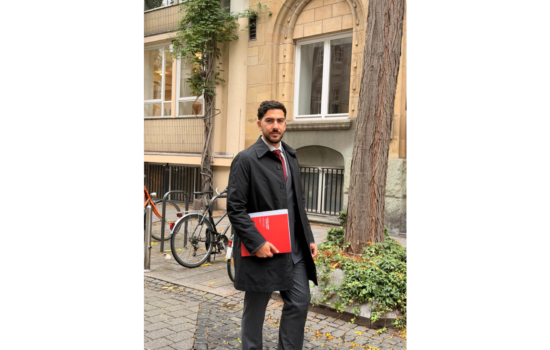
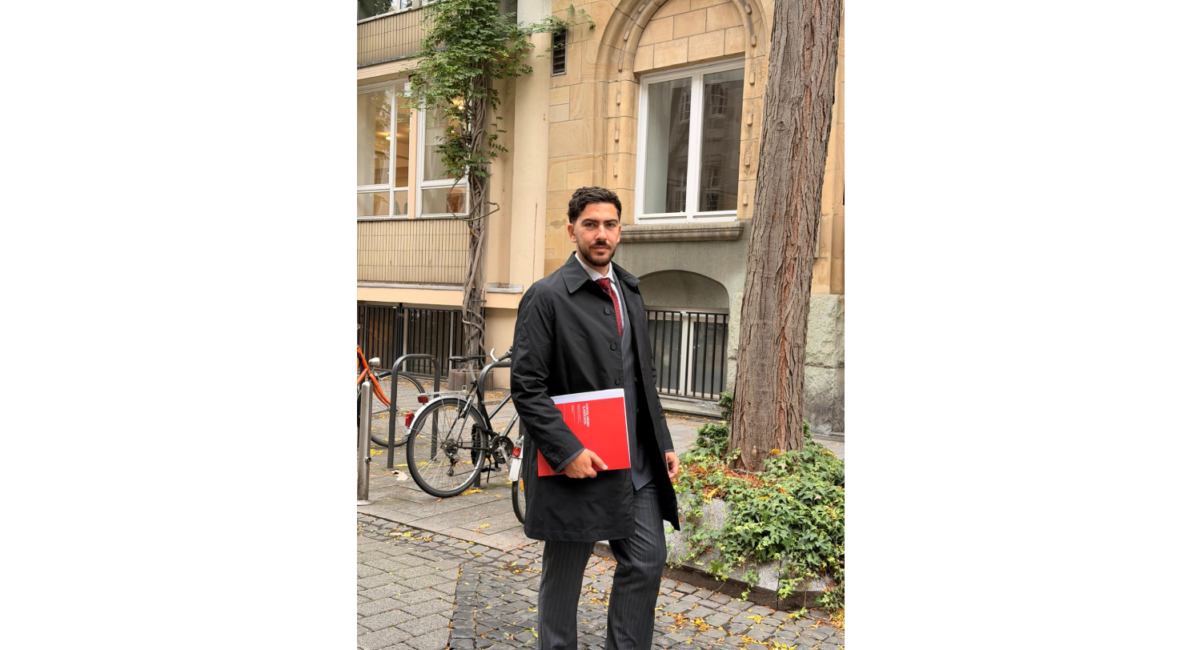
Between 22 and 24 October 2026, our colleague, attorney-at-law Paul Buzea, participated in the FBE Young Lawyers Human Rights Oratory Competition, held in Cologne, Germany, as a representative of the Cluj Bar Association.
The competition, held under the auspices of the Federation of European Bars (Fédération des Barreaux d’Europe – FBE), benefited from the valuable support of the Cologne Bar Association, whose involvement contributed significantly to the excellent organisation of the event. It brought together young lawyers from several European countries to debate a topical issue with important implications for both the protection of fundamental rights and the future of the legal profession.
This year’s topic was “SLAPP is a 21st Century instrument of law. What does this mean for the future of the legal profession?” Participants were invited to examine the phenomenon of Strategic Lawsuits Against Public Participation (SLAPPs), as well as lawyers’ responsibilities in the context of the abusive use of judicial proceedings.
In essence, SLAPPs are legal actions intended to intimidate or discourage individuals who participate in debates on matters of public interest, particularly journalists and representatives of civil society. In such cases, the objective is not necessarily to obtain a favourable court judgment, but rather to exert pressure on the defendant through the costs, duration and difficulties inherent in litigation.
In his speech, our colleague addressed this issue from the perspective of the relationship between freedom of expression and the right of access to justice, two fundamental rights that must both be protected. He also examined the lawyer’s role in identifying the boundary between the legitimate defence of a client’s interests and knowingly participating in the use of judicial proceedings for abusive purposes.
One of the central arguments of his speech was that a lawyer’s duty to defend their client’s interests does not entail the unconditional acceptance of every litigation strategy. Although lawyers cannot be held responsible for their clients’ concealed intentions, nor should they pass moral judgment on their clients, the practice of law requires independence and sound professional judgment when choosing the legal means to be employed.
This distinction becomes particularly important when legal proceedings, although ostensibly based on the exercise of a right, are in fact intended to discourage the expression of opinions or the publication of information on matters of public interest. The issue therefore concerns not only the limits of the right of access to justice, but also the responsibility of those involved in initiating and conducting judicial proceedings.
The discussion is particularly relevant in light of the adoption of Directive (EU) 2024/1069, through which the European legislature introduced procedural safeguards to protect persons targeted by manifestly unfounded claims or abusive court proceedings in civil and commercial matters with cross-border implications. Nevertheless, combating SLAPPs cannot depend exclusively on legislative measures or judicial intervention. It also requires reflection on the role lawyers play in preventing such practices.
Beyond the competition’s subject matter, participation in this event provided an opportunity to exchange ideas and experiences with lawyers from several European countries, including on how similar legal and ethical issues are approached in different legal systems. Such professional dialogue in an international setting contributes to a better understanding of the challenges shared by the legal profession and helps strengthen relationships between lawyers from different jurisdictions.
Participation in the Cologne edition also marked a continuation of the previous year’s experience, when our colleague represented the Cluj Bar Association at the same competition, held in Antwerp, Belgium.
This year’s topic brings an important question for the legal profession back into focus: where does the boundary lie between the legitimate defence of a client’s rights and the use of judicial proceedings as a means of intimidation? The answer concerns not only the regulation of SLAPPs, but also the way lawyers choose to practise their profession, with due regard for fundamental rights and the responsibilities incumbent upon them.
Costaș, Negru & Asociații is a law firm with offices in Cluj-Napoca, Bucharest, and Arad, providing legal assistance, representation, and consultancy across various practice areas through a team of 16 lawyers and consultants. Details regarding the legal services offered and the team composition can be found on the website https://www.costas-negru.ro. All rights to materials published on the firm’s website and via social media belong to Costaș, Negru & Asociații; reproduction of these materials is permitted solely for informational purposes and subject to correct and complete citation of the source.